
Openings
- Chess Atlas Subsections
- VOL. I • Chess HistoryFrom Chaturanga to Neural Engines
- VOL. II • Classic ChessPieces, Notation & Rules
- VOL. III • Legendary PlayersPantheon of Chess Immortals
- VOL. IV • Great GamesInteractive game studies
- VOL. V • OpeningsOriginal CAISSORA Opening Articles
- VOL. VI • Tactics & StrategyForks, Pins & Board Geometry
Benko Gambit
A pawn for open files
- Gambits
- Sharp play
- Asymmetry
Black pushes a pawn to b5 and offers it to White. In return he gets the open a- and b-files, quick development and a bishop on the long diagonal. The pawn stays missing for a long time, and Black has to be able to play without it. People choose this gambit when they want pressure and are not afraid of a pure sacrifice for long-term play.
8…g6
Moves
(16 plies • 8 moves)The g6 pawn prepares the bishop for g7 on the long diagonal. White's king is not yet safe, and Black is already pressing on the queenside.
- 1–8moves
- 1.
- 2.
- 3.
- 4.
- 5.
- 6.
- 7.
- 8.
Defining move
3…b5 — the pawn sacrifice
The move that makes the position a Benko Gambit
Black gives up a pawn to open the queenside. After …a6 and the exchange on a6 the a- and b-files open and the c8 bishop lands on a6, so White has trouble finishing development in peace. The idea rests not on a direct attack but on pressure that remains even without the pawn.
Tabiya
White's king on f1
White accepted the gambit and, after the bishops traded, lost the right to castle, but kept the pawn and the d5-e4 centre. Black plays without a pawn but has a bishop on g7, rooks on the a- and b-files, a queen on a5 and pressure on the queenside. White wants to walk the king to g2, place his knights and defend the a2 and b2 pawns. Black wants to give him no rest and keep the queenside open.
The centre
A closed centre and an open queensideWhite's pawns on d5 and e4 close the centre. Black's pawns on c5, d6 and g6 stay in place, while the a- and b-files are open. White's pawns on a2 and b2 become targets.
Key squaresd5e4b2g7
Outposts
- g7Black's bishop
- g2The king's refuge
Thematic breaks
- e6Black
The …e7-e6 strike
Hit d5, trade off the white pawn and open the game, especially when White's king is stuck in the centre.
What follows: After dxe6 Black gets an open centre and extra routes for his pieces.
- e5White
The e4-e5 advance
Push back the f6 knight and block the long diagonal for the g7 bishop before Black has finished development.
What follows: Black captures on e5 and gets open lines, but White can count on an attack in the centre.
White’s plan
- Walk the king to g2 and play h3 to finish development.
- Defend the a2 and b2 pawns with a rook and the queen.
- Keep the extra pawn and use the e4-e5 centre.
Black’s plan
- Finish development: …Bg7, …O-O, …Nbd7, the queen to a5.
- Place the rooks on the a- and b-files and press on b2 and a2.
- Not to hurry to win the pawn back: Black's play rests on pressure.
History
The idea of …b5 and …a6 appeared in the 1930s; the Czech master Karel Opočenský was one of the first to try it. In the USSR the gambit was called the Volga Gambit, after an article published in 1946. In the West it carries the name of the Hungarian-American grandmaster Pal Benko, who began to play and analyse the idea in the 1960s and made it popular.
Legends who played it
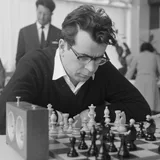 Pal Benkoas Black · Named after the player
Games in the Atlas
No games in the Atlas yet