
Openings
- Chess Atlas Subsections
- VOL. I • Chess HistoryFrom Chaturanga to Neural Engines
- VOL. II • Classic ChessPieces, Notation & Rules
- VOL. III • Legendary PlayersPantheon of Chess Immortals
- VOL. IV • Great GamesInteractive game studies
- VOL. V • OpeningsOriginal CAISSORA Opening Articles
- VOL. VI • Tactics & StrategyForks, Pins & Board Geometry
Benoni Defense
White gets the centre, Black gets the wing and the diagonal
- Sharp play
- Asymmetry
Black meets d4 with …c5 and, after d5, gives White the centre on purpose. In return Black gets a majority on the queenside and a g7 bishop that stares down the whole long diagonal. The positions are unbalanced: White has more room, Black has more counterplay. People pick it when they want to win with Black, not just to equalise.
7…Bg7
Moves
(14 plies • 7 moves)The bishop takes the long diagonal, from where it hits the centre and backs the pawn advance on the queenside.
- 1–7moves
- 1.
- 2.
- 3.
- 4.
- 5.
- 6.
- 7.
Defining move
5.cxd5 — the Benoni pawn structure
The move that turns the position into a Benoni
White captures with the pawn, and the asymmetry the whole line aims at appears. White has the centre: d5 and e4. Black has the queenside majority: a, b, c against a, b. So White plays in the centre, Black on the wing, and both plans are sharp. A peaceful draw is rare here.
Tabiya
The Modern Benoni
White owns the centre; Black owns the queenside majority and the g7 bishop. White wants to wait for a good moment for e4-e5, or to develop calmly, castle and bring a knight to c4 to hit d6. Black plans to castle, set up the pieces and strike with …b5. Each side has a clear plan, and a slip in timing is punished fast.
The centre
An asymmetrical structure: the centre against the wingWhite has pawns on d5 and e4 and only two on the queenside. Black has pawns on a7, b7, c5 and d6. The d6 square is weak, and White will lean on it. In return Black gets the g7 bishop and the chance to break on the wing.
Key squaresd6e5d4
Outposts
- c4White's knight
- e5A square for Black's knight
Thematic breaks
- b5Black
The …b7-b5 break
Use the queenside majority and open lines against White's king.
What follows: If White has not played a4 in time, Black gets a passed pawn or a dangerous attack.
- e5White
The e4-e5 advance
Break through at d6 and open lines on the kingside.
What follows: This is White's main trump. If it works, the d-pawn becomes a strong passed pawn and Black's position cracks.
- c4Black
The …c5-c4 push
Open the diagonal for the g7 bishop and gain space.
What follows: Black wins a square, but the c4 pawn can become weak if it is not supported.
White’s plan
- Prepare e4-e5 to get a strong passed pawn or open the kingside.
- Develop, castle and bring a knight to c4 to press on d6.
- Stop …b5 with a2-a4.
Black’s plan
- Castle and keep the bishop on the g7 long diagonal.
- Strike with …b5 and put the queenside majority in motion.
- Occupy e5 with a knight and press on the e-file before White gets in e4-e5.
History
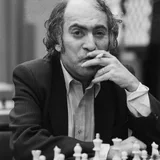
The word Benoni comes from Hebrew and means son of my sorrow. In the 1950s Soviet players revived the defence, and Mikhail Tal turned it into a fearsome weapon. Fischer played it in his 1972 match against Spassky.
Legends who played it
- M

Games in the Atlas
Lines below
- A40Benoni Defense: Franco-Sicilian Hybrid
- A43Benoni Defense: Benoni Gambit Accepted
- A43Benoni Defense: Benoni-Indian Defense2 lines
- A43Benoni Defense: Benoni-Staunton Gambit
- A43Benoni Defense: Cormorant Gambit
- A43Benoni Defense: French Benoni
- A43Benoni Defense: Hawk Variation
- A43Benoni Defense: Old Benoni6 lines
- A43Benoni Defense: Snail Variation
- A43Benoni Defense: Woozle
- A43Benoni Defense: Zilbermints-Benoni Gambit3 lines
- A44Benoni Defense: Semi-Benoni
- A56Benoni Defense: Czech Benoni Defense
- A56Benoni Defense: Hromádka System
- A56Benoni Defense: King's Indian System
- A56Benoni Defense: Weenink Variation
- A60Benoni Defense: Modern Variation2 lines
- A61Benoni Defense
- A61Benoni Defense: Fianchetto Variation4 lines
- A61Benoni Defense: Knight's Tour Variation
- A61Benoni Defense: Uhlmann Variation
- A65Benoni Defense: King's Pawn Line9 lines
- A66Benoni Defense: Mikenas Variation
- A66Benoni Defense: Pawn Storm Variation
- A67Benoni Defense: Taimanov Variation
- A68Benoni Defense: Four Pawns Attack2 lines
- A70Benoni Defense: Classical Variation12 lines
- Benoni Defense: Benoni Gambit