
Openings
- Chess Atlas Subsections
- VOL. I • Chess HistoryFrom Chaturanga to Neural Engines
- VOL. II • Classic ChessPieces, Notation & Rules
- VOL. III • Legendary PlayersPantheon of Chess Immortals
- VOL. IV • Great GamesInteractive game studies
- VOL. V • OpeningsOriginal CAISSORA Opening Articles
- VOL. VI • Tactics & StrategyForks, Pins & Board Geometry
Catalan Opening
The queen's gambit with a bishop on g2
- Fianchetto
- Positional play
White sets up pawns on c4 and d4 and adds a bishop on g2. The bishop presses along the long diagonal on d5, c6 and b7, while the king stays safe behind it. The edge is small but hard to remove, and White can keep the pressure on for many moves. That is why the Catalan suits players who like to be patient and exact.
8…b5
Moves
(16 plies • 8 moves)The pawn attacks the queen, and she has to retreat. Black gains space on the queenside but weakens it.
- 1–8moves
- 1.
- 2.
- 3.
- 4.
- 5.
- 6.
- 7.
- 8.
Defining move
3.g3! — the bishop to the long diagonal
The move that turns a queen's gambit into the Catalan
White does not rush the knight to c3 and fianchettoes instead. The g2 bishop will press on the d5 pawn and on Black's whole queenside. Meanwhile the c4 and d4 pawns hold the centre. The king stays safe and the pressure does not let up.
Tabiya
The Open variation: …b5
The white queen has taken the c4 pawn, and …b5 drives her away. After she retreats, Black will put the bishop on b7 and contest the long diagonal. Black now has space on the queenside, but also weak points there. White wants to use those weaknesses and keep the g2 bishop pressing, while Black wants to hold the diagonal and trade pieces at the right moment.
The centre
A queen's gambit with diagonal pressureWhite keeps pawns on d4 and g3, and the c4 pawn has been exchanged. Black has e6 and pawns on the queenside. The g2–a8 diagonal is not blocked by anything, and Black must reckon with the g2 bishop on every move.
Key squaresc4d5b7
Outposts
- g2White's bishop
- c4The disputed pawn
Thematic breaks
- b5Black
The …b7-b5 strike
Keep the extra pawn and drive the white queen from c4.
What follows: Black gains space but weakens c6 and a6.
- e4White
The e2-e4 advance
Occupy the centre with pawns once the pieces are developed.
What follows: If Black cannot respond in time, White gets both space and the g2 bishop's pressure.
- c5Black
The …c7-c5 strike
Hit d4 and free the game by exchanges.
What follows: The position opens and the g2 bishop gains even more scope, but Black has more chances to trade pieces.
White’s plan
- Press with the g2 bishop along the long diagonal on b7, c6 and d5.
- Win back the c4 pawn and keep the lead in development.
- Use the weaknesses Black creates with …b5.
Black’s plan
- Keep the pawn with …b5 or give it back at a good moment.
- Put the bishop on b7 and contest the long diagonal.
- Free the game with …c5 and piece exchanges.
History
At the Barcelona tournament of 1929 Savielly Tartakower played this set-up, and it was named in honour of Catalonia. Capablanca, Alekhine and Botvinnik used it. In the 1983 Candidates semi-final Kasparov and Korchnoi played it in five games, and Kramnik used it in World Championship matches.
Legends who played it
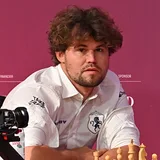 Magnus Carlsenas White · Signature opening
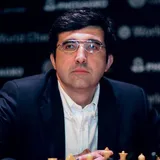 Vladimir Kramnikas White · Signature opening
 Ding Lirenas White · In the repertoire
Games in the Atlas
No games in the Atlas yet