
Openings
- Chess Atlas Subsections
- VOL. I • Chess HistoryFrom Chaturanga to Neural Engines
- VOL. II • Classic ChessPieces, Notation & Rules
- VOL. III • Legendary PlayersPantheon of Chess Immortals
- VOL. IV • Great GamesInteractive game studies
- VOL. V • OpeningsOriginal CAISSORA Opening Articles
- VOL. VI • Tactics & StrategyForks, Pins & Board Geometry
Scandinavian Defense
The queen goes first
- Solid
Black meets 1.e4 with the most direct move there is: 1…d5, and the pawn hits e4 at once. After 2.exd5 Black takes the pawn with the queen and accepts that it must run from a knight. In return Black gets a simple, sturdy position and a clear plan of development. It suits players who do not mind giving up a little space for clarity.
7…e6
Moves
(14 plies • 7 moves)The e6 pawn supports d5 and opens the way for the f8 bishop.
- 1–7moves
- 1.
- 2.
- 3.
- 4.
- 5.
- 6.
- 7.
Defining move
1…d5 — the strike without preparation
The move that sets the Scandinavian apart from the French and the Caro–Kann
Other defences first prop up d5 with a pawn on c6 or e6. Here the pawn goes to d5 alone, and after 2.exd5 Black has to find a way to win it back. The most common way is with the queen. Black pays in time but gets open play and free bishops.
Tabiya
The main line with 3…Qa5
Black has developed the knight and the bishop and built a sturdy c6–e6 chain with the queen on a5. White has more space and a small lead in development. Either side can castle either way. White looks for activity: Qe2, castling and a knight jump to e5. Black wants to finish development, trade the light-squared bishops and equalise calmly.
The centre
An open centre with a Caro–Kann-like pawn chainWhite has a pawn on d4 and no e-pawn, since it was traded on d5. Black has pawns on c6 and e6 and no d-pawn either. Black has almost no weak squares, and the bishop works outside the chain.
Key squaresd5e5f5
Outposts
- e5The white knight's outpost
- f5Black's free bishop
Thematic breaks
- Ne5White
The knight jump to e5
Take a central square and hit c6, d7 and f7.
What follows: If Black is not ready, weaknesses appear. That is why Black puts a bishop on g4 in advance or trades the knight.
- Ne4Black
The knight jump to e4
Hit the c3 knight and the d2 bishop and trade off one of White's pieces.
What follows: The trade relieves the cramp, and Black frees the game without extra effort.
- Bb4Black
The bishop sortie to b4
Add to the queen's pressure on the c3 knight and disrupt White's plans in the centre.
What follows: White has to decide how to protect the knight and loses time.
White’s plan
- Use the extra tempi: develop quickly and castle.
- Put a knight on e5 and prepare Qe2 or Re1.
- Do not let Black trade the light-squared bishops in peace.
Black’s plan
- Finish development: …e6, …Nbd7, …Be7 and castling.
- Trade the light-squared bishops and relieve the pressure.
- Use the active queen and the jumps …Ne4 or …Bb4.
History
The Scandinavian is one of the oldest openings there is: its moves appear in the Catalan poem Scachs d'amor of 1475. It used to be called the Centre Counter. In the late nineteenth century Blackburne and Mieses played it, and in the early twentieth Capablanca did. Interest returned when Bent Larsen beat Karpov with it at Montreal in 1979.
Legends who played it
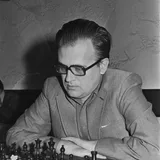 Bent Larsenas Black · In the repertoire
Games in the Atlas
No games in the Atlas yet
Lines below
- B01Scandinavian Defense
- B01Scandinavian Defense: Anderssen Counterattack4 lines
- B01Scandinavian Defense: Blackburne Gambit
- B01Scandinavian Defense: Blackburne-Kloosterboer Gambit
- B01Scandinavian Defense: Boehnke Gambit
- B01Scandinavian Defense: Bronstein Variation
- B01Scandinavian Defense: Classical Variation
- B01Scandinavian Defense: Grünfeld Variation
- B01Scandinavian Defense: Gubinsky-Melts Defense
- B01Scandinavian Defense: Icelandic-Palme Gambit
- B01Scandinavian Defense: Kádas Gambit
- B01Scandinavian Defense: Kiel Variation
- B01Scandinavian Defense: Kloosterboer Gambit
- B01Scandinavian Defense: Lasker Variation
- B01Scandinavian Defense: Main Line3 lines
- B01Scandinavian Defense: Marshall Variation
- B01Scandinavian Defense: Mieses-Kotroc Variation
- B01Scandinavian Defense: Modern Variation4 lines
- B01Scandinavian Defense: Panov Transfer
- B01Scandinavian Defense: Portuguese Gambit9 lines
- B01Scandinavian Defense: Richter Variation2 lines
- B01Scandinavian Defense: Schiller-Pytel Variation2 lines
- B01Scandinavian Defense: Valencian Variation3 lines
- B01Scandinavian Defense: Zilbermints Gambit