
Openings
- Chess Atlas Subsections
- VOL. I • Chess HistoryFrom Chaturanga to Neural Engines
- VOL. II • Classic ChessPieces, Notation & Rules
- VOL. III • Legendary PlayersPantheon of Chess Immortals
- VOL. IV • Great GamesInteractive game studies
- VOL. V • OpeningsOriginal CAISSORA Opening Articles
- VOL. VI • Tactics & StrategyForks, Pins & Board Geometry
Queen's Indian Defense
A bishop on b7 stares across the whole board
- Fianchetto
- Positional play
- Hypermodern
Black prepares to fianchetto the queen's bishop with …b6. The bishop on b7 presses on e4 and on White's centre, while Black leaves the centre pawns for later. White's 3.Nf3 also sidesteps the Nimzo-Indian, which would arise after 3.Nc3 Bb4. The positions are flexible and free of weaknesses, so the defence suits players who want safety without passivity.
7…Ne4
Moves
(14 plies • 7 moves)The knight jumps onto the very square White wanted for a pawn. The b7 bishop backs it up, and it is hard to chase the knight away without trading one of your own.
- 1–7moves
- 1.
- 2.
- 3.
- 4.
- 5.
- 6.
- 7.
Defining move
3…b6! — the bishop gets its diagonal
The move that sets the Queen's Indian apart from the other Indian systems
Black does not pin the knight as in the Nimzo-Indian but puts the bishop on b7. From there it watches e4 and the whole long diagonal. Black leaves the centre alone for now, waits for White to commit pawns, and then hits them with pieces. The name says the same: this is all about the queen's bishop.
Tabiya
The main 4.g3 system
Both kings are safe and both bishops stand on long diagonals. The black knight has landed on e4 and contests the key square. White often follows with Qc2, trades knights on c3 and recaptures with the queen, and Black answers with …c5. White wants to use the extra space and set up pawns in the centre, while Black wants to keep the b7 bishop busy and avoid weaknesses.
The centre
A flexible centre: Black plays with pieces, White with spaceWhite has pawns on c4 and d4 and a g3 pawn behind the bishop. Black has pawns on e6 and b6: few weak squares, but no centre yet. The fight is over who first manages to put a pawn on e4, d5 or c5.
Key squarese4d5c5
Outposts
- e4The e4 square
- b7The bishop on the long diagonal
Thematic breaks
- c5Black
The …c7-c5 strike
Challenge the d4 pawn and open the way for the c6 knight and the queen.
What follows: If White has not shored up d4 in time, Black equalises.
- d5Black
The …d7-d5 thrust
Take the centre with a pawn once the b7 bishop and the f6 knight are ready to support it.
What follows: A white knight often jumps to e5, and a sharp fight breaks out around that square.
- e4White
The e2-e4 advance
Build a big centre and push away the knight or the bishop on the diagonal.
What follows: If Black has not struck at the centre in time, White keeps the space for a long time.
White’s plan
- Do not let the black knight settle on e4: Qc2 and a trade on c3.
- Use the space and prepare e2-e4 or d4-d5.
- Keep the g2 bishop on its diagonal and press on the queenside.
Black’s plan
- Put the knight on e4 and trade it to ease the cramp.
- Win the centre back with …c5 or …d5.
- Keep the b7 bishop on its diagonal and play without weaknesses.
History
The defence was developed by the hypermodernists of the early twentieth century, Aron Nimzowitsch among them. In the 1920s and 1930s strong masters took it up willingly. The move 4.a3 carries Petrosian's name, and Kasparov played that setup with success as White.
Famous games
The Immortal Zugzwang Game (1923)Legends who played it

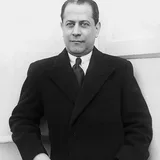
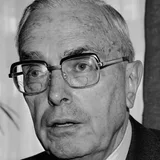
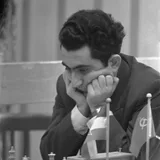 Tigran Petrosianas White · Named after the player
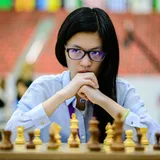 Hou Yifanas Black · Signature opening
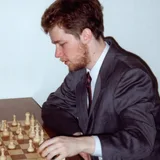 Alexander Khalifmanas Black · In the repertoire
 Anatoly Karpovas Black · In the repertoire
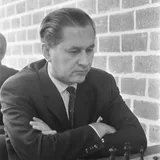 Paul Kereswith both colours · In the repertoire
 Veselin Topalovas White · In the repertoire
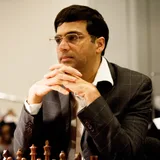 Viswanathan Anandas Black · In the repertoire
Lines below
- E12Queen's Indian Defense: Kasparov Variation3 lines
- E12Queen's Indian Defense: Kasparov-Petrosian Variation12 lines
- E12Queen's Indian Defense: Miles Variation
- E12Queen's Indian Defense: Petrosian Variation2 lines
- E14Queen's Indian Defense, with e315 lines
- E14Queen's Indian Defense: Averbakh Variation
- E14Queen's Indian Defense: Spassky System4 lines
- E14Queen's Indian Defense: Spassky System32 lines
- E15Queen's Indian Defense: Buerger Variation
- E15Queen's Indian Defense: Fianchetto Variation12 lines
- E16Queen's Indian Defense: Capablanca Variation4 lines
- E16Queen's Indian Defense: Riumin Variation3 lines
- E16Queen's Indian Defense: Yates Variation
- E17Queen's Indian Defense: Anti-Queen's Indian System
- E17Queen's Indian Defense: Classical Variation7 lines
- E17Queen's Indian Defense: Euwe Variation
- E17Queen's Indian Defense: Opocensky Variation
- E17Queen's Indian Defense: Traditional Variation